English
- English
- Español
- Português
- русский
- Français
- 日本語
- Deutsch
- tiếng Việt
- Italiano
- Nederlands
- ภาษาไทย
- Polski
- 한국어
- Svenska
- magyar
- Malay
- বাংলা ভাষার
- Dansk
- Suomi
- हिन्दी
- Pilipino
- Türkçe
- Gaeilge
- العربية
- Indonesia
- Norsk
- تمل
- český
- ελληνικά
- український
- Javanese
- فارسی
- தமிழ்
- తెలుగు
- नेपाली
- Burmese
- български
- ລາວ
- Latine
- Қазақша
- Euskal
- Azərbaycan
- Slovenský jazyk
- Македонски
- Lietuvos
- Eesti Keel
- Română
- Slovenski
- मराठी
- Srpski језик
How to Safely Pack Custom Glass Bottles for Ocean Freight and Reduce Breakage: 2026 Guide for Importers
Shipping glass bottles across international markets requires more than placing products in cartons and loading them into a container. During ocean freight, glass packaging may experience repeated vibration, sudden impacts, pressure from stacked cartons, humidity changes, and movement during loading and unloading. Without suitable protection, even well-manufactured bottles can arrive with chipped necks, cracked bases, or damaged surfaces.
For importers, distributors, and beverage brands sourcing custom glass liquor bottles, packaging should be considered during the purchasing and product development stages rather than treated as the final step before shipment. Bottle shape, glass weight, neck design, closure type, carton dimensions, and shipping conditions all influence the choice of protective materials.
With experience in glass packaging production and international supply since 1980, HYT Packaging understands the importance of coordinating bottle specifications with packaging and transportation requirements. This guide explains how to select suitable packing materials, prepare glass bottles for export, prevent common shipping damage, and evaluate packaging costs more effectively in 2026.
What Are the Best Packing Materials for Ocean Freight of Glass Bottles?
The right packaging system depends on bottle dimensions, weight, shape, order quantity, and the expected handling conditions. A standard cylindrical bottle generally requires a different protective structure from a heavy-bottomed whiskey bottle or a custom-shaped decanter.
Cardboard Dividers vs. Foam Inserts vs. Air Cushions
Three commonly used materials for glass bottle packaging are corrugated cardboard dividers, foam inserts, and air cushions. Each offers different levels of protection, cost efficiency, and material sustainability.
| Packaging Material | Main Advantages | Limitations | Suitable Applications |
|---|---|---|---|
| Cardboard Dividers | Economical, lightweight, recyclable, and easy to assemble | Limited cushioning against strong impacts | Standard cylindrical glass bottles |
| PE/PU Foam Inserts | Provides individual support and absorbs impact | Higher material costs and more difficult recycling | Premium spirits bottles and custom-shaped glass bottles |
| Air Cushions | Lightweight and flexible for filling empty spaces | Performance depends on sealing and pressure resistance | Secondary cushioning and selected lightweight packaging |
Cardboard dividers are a practical option for standard bottle designs. They create separate compartments and prevent direct glass-to-glass contact. When combined with properly sized cartons and cushioning pads, they can provide adequate protection for many bulk shipments.
Foam inserts offer more precise protection because their cavities can be designed around individual bottle profiles. This is particularly useful for premium spirits packaging, heavy glass bases, embossed surfaces, and unique shape glass bottles. The insert should support the bottle without concentrating excessive pressure around the neck, shoulder, or base.
Air cushions are useful for filling voids and reducing movement inside secondary packaging. However, they should not be the only protective measure for heavy glass products. Long transportation periods, temperature fluctuations, and compression from surrounding cartons can affect their performance.
Choosing Corrugated Cartons and Wooden Crates
The outer carton is responsible for protecting the entire package from stacking pressure, handling impacts, and movement during transportation. Its compression strength should be selected according to the total packed weight, carton dimensions, stacking height, and expected storage conditions.
Single-wall corrugated cartons may be sufficient for some lightweight shipments, but double-wall or stronger corrugated cartons are generally more suitable for heavier glass bottle orders. For large-format bottles, high-value decanters, or products with unusual shapes, reinforced cartons or wooden crates may provide additional structural support.
When evaluating carton strength, buyers can review the Edge Crush Test (ECT) rating and the manufacturer's box specifications. The packaging should also be tested under realistic stacking conditions rather than selected based on material thickness alone.
Wooden crates offer additional rigidity, but they increase shipping weight and handling costs. For international shipments, wood packaging materials must also comply with applicable import requirements, including ISPM 15 where relevant.
Moisture Protection During Ocean Transportation
High humidity and condensation can weaken paper-based packaging during long sea voyages. This is especially important when containers experience temperature changes between ports, tropical climates, and inland destinations.
Several measures can help reduce moisture-related problems:
- Use suitable desiccants based on container conditions, cargo volume, and expected transit time.
- Keep cartons and pallets away from direct contact with wet container floors and walls.
- Use appropriate moisture-resistant liners or protective bags when required.
- Apply stretch film and protective top covers to reduce exposure to external moisture.
- Inspect containers for leaks, water damage, and condensation before loading.
Desiccants help control moisture inside enclosed packaging, but they cannot compensate for water entering a damaged container. A complete moisture-control plan should consider container condition, ventilation, cargo arrangement, and the properties of the packaging materials.
How to Pack Custom Glass Bottles Step by Step to Prevent Breakage
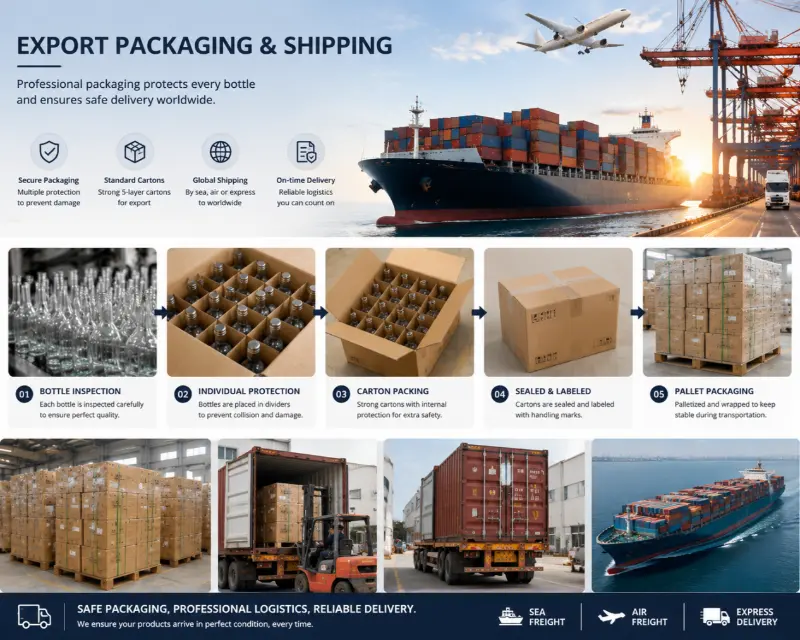
A reliable glass bottle packing process begins with product inspection and ends with proper container loading. Each stage addresses a different source of potential damage, so skipping one step can affect the performance of the entire packaging system.
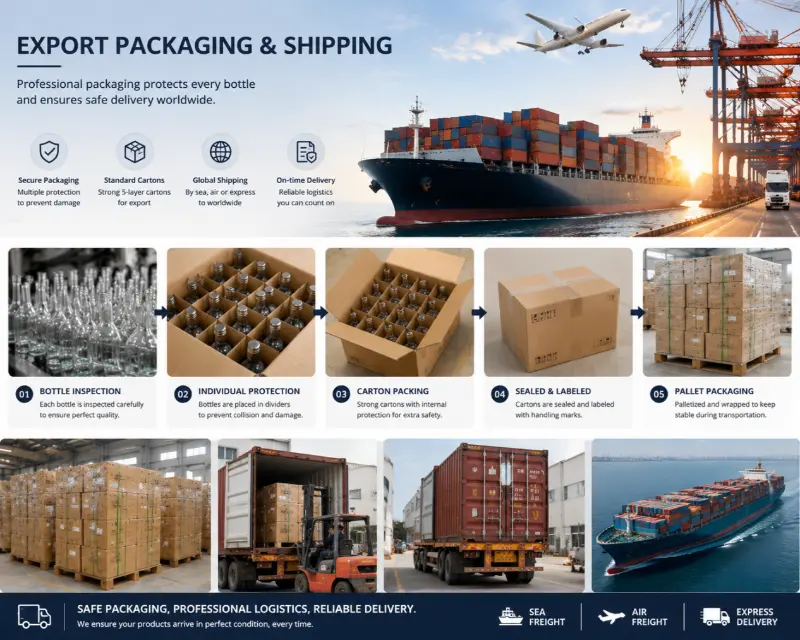
Step 1: Inspect Glass Bottles Before Packing
Before packaging, bottles should be checked for visible cracks, chips, bubbles, surface defects, dimensional deviations, and other issues that may affect their performance.
Particular attention should be paid to the bottle mouth, neck, shoulder, body, and base. These areas are important for closure compatibility, filling operations, structural stability, and transportation safety.
For customized orders, inspection should also confirm that the actual bottle dimensions and appearance match the approved sample or production specifications. Where required, automated inspection equipment and manual checks can be used together to identify defects before products enter the packing process.
Step 2: Wrap Each Bottle Individually
Individual protection reduces direct contact between bottles and helps absorb minor impacts during transportation. Bubble wrap, polyethylene foam sleeves, and custom protective materials can all be used depending on the bottle design.
For standard bottles, bubble wrap may provide sufficient surface protection when combined with individual carton compartments. For heavier or irregularly shaped bottles, custom foam sleeves or molded inserts can provide more stable support.
Make sure the neck, shoulder, and base are adequately protected. These areas should not be left exposed to friction or direct contact with dividers. The protective material should fit securely without applying excessive pressure to the glass.
Step 3: Arrange Bottles with Individual Compartments
Glass bottles should not touch one another or move freely inside the carton. Individual compartments made from corrugated cardboard or molded inserts help maintain separation throughout the journey.
For multi-layer packaging, place a flat corrugated pad or suitable cushioning sheet between layers to distribute the weight more evenly. Heavier bottles should generally be positioned in the lower layers, provided the cartons are designed to withstand the resulting load.
There is no universal maximum number of layers suitable for every glass bottle shipment. The correct stacking arrangement depends on bottle weight, carton compression strength, divider design, and the total package load. A trial packing test is recommended before approving a large production shipment.
Step 4: Seal and Label Cartons Correctly
Cartons should be sealed with tape suitable for the expected humidity and storage conditions. Reinforced packing tape or water-activated tape can provide more reliable sealing than ordinary low-strength tape for demanding export applications.
Common handling labels include:
- Fragile: Identifies cartons containing breakable glass products.
- This Side Up: Indicates the intended carton orientation.
- Keep Dry: Highlights the need for moisture protection.
- Handling Instructions: Provides additional guidance where required.
Labels help communicate handling requirements, but they do not replace adequate physical protection. Export documentation, carton markings, package quantities, and declared weights should also be checked before shipment.
Step 5: Palletize and Stabilize the Cargo
Proper palletization helps prevent cartons from shifting, leaning, or collapsing during warehouse handling and transportation. Cartons should be arranged according to their dimensions and weight, with heavier packages generally placed at the bottom.
For improved stability, consider the following measures:
- Use pallets with sufficient load-bearing capacity.
- Arrange cartons in stable columnar or interlocking patterns as appropriate.
- Place anti-slip sheets between layers when needed.
- Install corner protectors to reduce edge damage.
- Apply suitable stretch film to secure the palletized load.
- Avoid excessive wrapping tension that may crush carton corners.
Before loading, inspect the pallet for loose cartons, uneven weight distribution, and protruding packages. A stable pallet is easier to handle and less likely to experience movement-related damage during transportation.
Step 6: Secure Pallets Inside the Shipping Container
Even well-packed pallets can be damaged if they move inside a shipping container. Gaps between pallets, container walls, and cargo sections should be evaluated during loading.
Depending on the cargo arrangement, suitable securing methods may include inflatable dunnage bags, wooden bracing, blocking materials, and load restraints. The objective is to prevent cargo movement without placing excessive pressure on the cartons.
Weight distribution should also be considered. Uneven loading can affect cargo stability and increase the risk of shifting during vessel movement, port handling, and inland transportation.
What Are the Common Mistakes When Shipping Glass Bottles by Sea?
Glass breakage is not always caused by a single major impact. In many cases, damage develops from a combination of insufficient cushioning, repeated vibration, carton compression, and poor cargo stabilization.
Underestimating Vibration and Repeated Impact
Ocean freight involves more than the movement of a vessel. Containers are exposed to handling during port operations, lifting, truck transportation, and warehouse transfers. Repeated low-level vibration can also cause bottles to rub against dividers or neighboring packaging when internal clearance is insufficient.
Packaging designed only for short-distance road transportation may not provide adequate protection for a longer international supply chain. Buyers should consider the complete transportation route when selecting cushioning materials and carton structures.
Where appropriate, vibration testing can help evaluate packaging performance. ASTM D4728 provides a recognized method for random vibration testing of shipping containers and systems.
Using Incorrect Carton Dimensions
A carton that is too large allows bottles to move during handling, increasing the possibility of collision. A carton that is too small may compress the protective materials or place unwanted pressure on the bottle surface.
Custom-sized packaging is particularly important for irregular bottle shapes. The internal compartments should match the actual bottle dimensions, including the neck, shoulders, base, and any decorative features.
Ignoring Temperature and Humidity Changes
Glass itself is not damaged by humidity in the same way as paper packaging, but environmental conditions can affect cartons, adhesives, labels, and cushioning materials.
For shipments to regions with significant temperature or humidity variations, packaging materials should be selected and evaluated under conditions representative of the intended route. Moisture-resistant cartons, suitable adhesives, and appropriate desiccant arrangements can help maintain package integrity.
Failing to Secure Pallets Properly
Stretch film alone may not be sufficient to stabilize a heavy pallet. Without suitable corner protection, anti-slip materials, and internal load restraints, cartons can gradually shift or become exposed during transportation.
For this reason, pallet stability should be checked before container loading, and the final cargo arrangement should be documented with photographs where possible.
How Much Does Professional Glass Bottle Packaging Cost?
Packaging costs depend on several variables, including bottle weight, dimensions, order quantity, protection requirements, and shipping destination. A standard cylindrical bottle packed in a corrugated carton will generally require a different budget from a custom decanter with molded foam protection.
Main Factors Affecting Packaging Costs
| Cost Factor | What Affects the Cost? |
|---|---|
| Internal Protection | Cardboard dividers, foam inserts, molded pulp, and individual sleeves vary in material and production costs. |
| Outer Cartons | Carton dimensions, corrugated layers, compression strength, and printing requirements influence pricing. |
| Moisture Protection | Desiccants, barrier bags, protective liners, and pallet covers add to packaging expenses. |
| Palletization | Pallet type, corner protectors, stretch film, and additional securing materials affect the total cost. |
| Labor and Handling | Individual wrapping, customized packing, inspection, and container loading require additional labor. |
Evaluating Packaging Costs Against Potential Losses
The lowest packaging price does not necessarily result in the lowest overall shipping cost. Importers should also consider product replacement, freight expenses, insurance procedures, delayed deliveries, and the time required to resolve damage claims.
For example, a shipment of 10,000 glass bottles with a declared product value of $5 per bottle represents $50,000 in merchandise value. Even a relatively small breakage rate can result in considerable losses, especially when damaged products affect a scheduled retail launch or customer delivery.
When comparing packaging options, buyers can calculate the total cost per usable bottle rather than looking only at the cost of the carton or insert. This provides a more practical basis for deciding whether additional protection is justified.
Why Custom Packaging Can Be Worth Considering
Custom packaging is particularly relevant for premium spirits bottles, limited-edition products, and bottles with complex geometries. A properly designed insert can reduce unnecessary movement, protect decorative surfaces, and improve packing consistency.
However, customized inserts and reinforced cartons also involve additional design and tooling costs. For large-volume projects, these costs can be distributed across more units. For smaller orders, standard bottle designs and existing packaging structures may offer a more economical starting point.
Sustainable Packaging Options for Glass Bottles in 2026
Environmental considerations are becoming increasingly important for beverage brands and packaging importers. Many businesses are reviewing their use of plastic cushioning, reducing unnecessary packaging weight, and exploring recyclable materials.
Molded Pulp and Paper-Based Protection
Molded pulp inserts are made from formed paper fibers and can be designed to fit specific bottle profiles. They offer an alternative to some conventional foam inserts and are suitable for projects where fiber-based packaging is a priority.
Corrugated paper structures and honeycomb paper materials can also provide cushioning and separation. Their actual protective performance should be verified according to bottle weight, carton configuration, and expected transportation conditions.
Reducing Unnecessary Packaging Materials
More packaging does not always mean better protection. Excessive void filling can increase shipping volume and material consumption without improving cargo stability.
Optimizing carton dimensions, selecting suitable dividers, and improving pallet loading efficiency can help reduce material usage while maintaining adequate protection.
Lightweight Glass Bottle Design
Reducing bottle weight can lower the total cargo weight and potentially improve transportation efficiency. However, lightweight glass design requires careful engineering because changes in wall thickness and glass distribution may affect mechanical performance.
For custom bottle projects, designers should evaluate the relationship between appearance, filling requirements, glass distribution, base stability, and transportation protection before approving a lightweight design.
Glass Bottle Shipping and Packaging Trends to Watch in 2026
Changes in packaging technology, environmental requirements, and international logistics are influencing how glass bottles are prepared for export. Several developments are particularly relevant to importers and distributors.
More Consistent Inspection and Automated Packing
Automated inspection systems can help identify visible defects, dimensional inconsistencies, and irregularities during production. Automated packing equipment can also improve the consistency of carton loading for standardized bottle formats.
For customized products and smaller production runs, manual inspection remains important because unusual bottle profiles and decorative finishes may require additional attention.
Greater Demand for Recyclable Protective Materials
Paper-based dividers, molded pulp inserts, and recyclable corrugated cartons are receiving more attention as brands review their packaging materials. The suitability of each option depends on the required protection level, local recycling infrastructure, and destination-market regulations.
Importers selling into the European Union should also monitor applicable packaging and packaging-waste requirements, including the implementation of Regulation (EU) 2025/40. Compliance depends on the relevant product, packaging category, and applicable implementation dates.
Digital Monitoring for High-Value Shipments
For sensitive or high-value cargo, shipment monitoring devices can record environmental conditions and handling events throughout transportation. Depending on the device, recorded information may include temperature, humidity, shock, and tilt.
These tools can help logistics teams investigate potential damage and identify weak points in the transportation process. They are generally more relevant to high-value or sensitive shipments than to every standard glass bottle order.
Which Packaging Tests Help Verify Glass Bottle Shipping Safety?
Packaging should be evaluated according to the transportation conditions it is expected to withstand. Visual inspection alone cannot establish whether a carton and cushioning system will remain effective throughout a long export journey.
ISTA and ASTM Testing Standards
Several recognized testing standards can help packaging engineers evaluate shipping performance:
- ISTA 3A: A packaged-product testing procedure designed for individual packaged products shipped through parcel delivery systems. It should not automatically be treated as a complete ocean-freight qualification.
- ASTM D4169: Provides a framework for evaluating shipping containers and systems under distribution hazards, with test sequences selected according to the distribution cycle.
- ASTM D4728: Covers random vibration testing of shipping containers and systems to evaluate their response to transportation-related vibration.
The appropriate testing procedure depends on the shipping method, packaging configuration, product characteristics, and customer requirements. For a containerized ocean shipment, testing should reflect the actual distribution environment rather than relying on a parcel-delivery test alone.
Why Pre-Shipment Testing Matters
Testing provides a way to identify weaknesses before products are shipped in commercial quantities. Depending on the project, this may include carton compression testing, drop testing, vibration testing, and environmental conditioning.
For custom glass bottles, a useful evaluation should examine both the protective packaging and the bottle itself. The neck, shoulder, base, and decorative surfaces may respond differently to repeated handling and impact.
Importers can discuss testing requirements with their packaging supplier or an independent testing laboratory before finalizing the export packing specification.
Pre-Shipment Glass Bottle Packaging Checklist
Before approving a glass bottle shipment, importers and distributors can use the following checklist to review the main packaging and loading requirements.
- Confirm that bottles have passed the agreed quality inspection.
- Check that bottle dimensions match the approved packaging design.
- Verify that individual bottles are adequately protected.
- Ensure dividers or inserts prevent direct glass-to-glass contact.
- Confirm that carton strength matches the packed weight and stacking requirements.
- Check whether moisture protection is suitable for the shipping route.
- Verify carton sealing and handling labels.
- Inspect pallet condition, load arrangement, and corner protection.
- Ensure pallets are properly secured inside the container.
- Record package quantities, shipment weights, and loading photographs.
- Confirm that export documents and destination-market requirements are complete.
How to Work with a Glass Bottle Supplier on Export Packaging
Safe ocean freight starts with communication between the buyer, bottle supplier, packaging team, and logistics provider. Packaging requirements are easier to confirm when they are discussed alongside bottle design and production specifications.
For example, a heavy 750ml whiskey bottle may require stronger carton support than a lightweight miniature bottle. A custom decanter with curved shoulders or an irregular base may need a specially shaped insert to prevent movement. These requirements should be identified before mass production and final packing arrangements are confirmed.
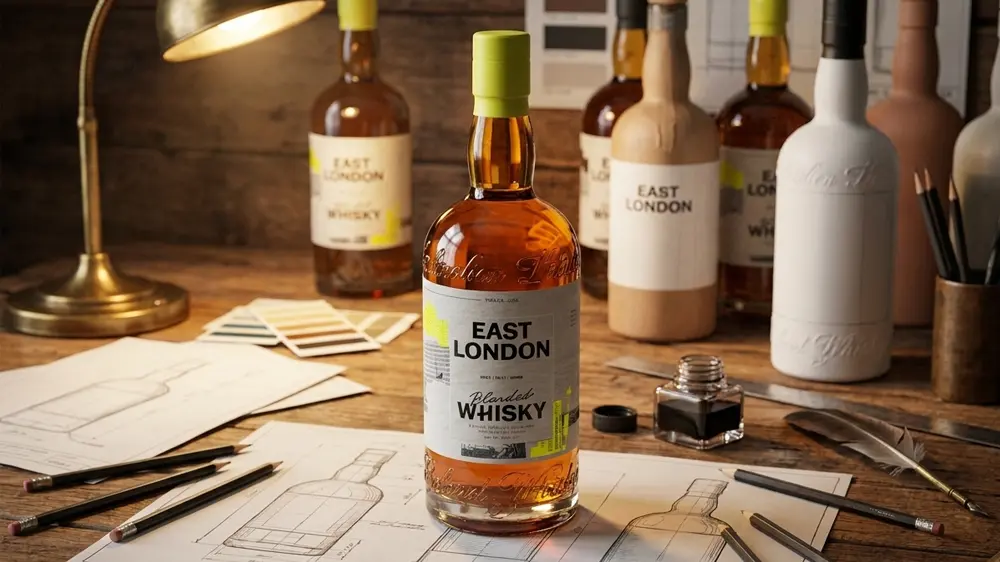
HYT Packaging provides glass packaging solutions for spirits brands, importers, wholesalers, and distributors. Its product range includes standard and customized liquor bottles, unique-shaped bottles, and stock glass bottle options. Buyers can also discuss bottle design, mold development, decoration, matching closures, and export packaging as part of their project.
For customers who already have a bottle concept, drawing, or reference sample, the custom glass bottle development process provides a starting point for reviewing design requirements and moving toward sampling and production.
Before confirming an order, it is useful to provide the supplier with the following information:
- Bottle capacity, dimensions, and approximate weight.
- Bottle shape, glass color, and surface decoration requirements.
- Neck finish and compatible closure specifications.
- Expected order quantity and packaging configuration.
- Destination country and preferred shipping method.
- Any special carton strength, testing, or labeling requirements.
These details help establish a more practical packaging plan and reduce the need for last-minute adjustments before shipment.
Conclusion: Make Packaging Part of the Glass Bottle Procurement Process
Preventing glass bottle breakage during ocean freight requires a coordinated approach to product inspection, internal cushioning, carton strength, moisture control, palletization, and container loading. No single material can eliminate every transportation risk. The most effective solution is a packaging system designed around the actual bottle structure, cargo weight, and shipping conditions.
For importers and distributors sourcing custom glass bottles, discussing export packaging during the early stages of product development can help avoid unnecessary costs and improve delivery reliability.
HYT Packaging has been involved in the glass packaging industry since 1980, supporting international customers with bottle selection, custom development, production coordination, and packaging solutions. Whether you are sourcing standard spirits bottles or developing a distinctive custom design, the team can review your product specifications and discuss suitable packaging arrangements for your target market.
If you are planning a new glass bottle order or looking to improve the packaging of an existing product, contact HYT Packaging to discuss your bottle requirements, order quantity, and export destination.
References and Further Reading
- International Safe Transit Association (ISTA) – Packaging Performance Testing Standards.
- ASTM International – ASTM D4169, Standard Practice for Performance Testing of Shipping Containers and Systems.
- ASTM International – ASTM D4728, Standard Test Method for Random Vibration Testing of Shipping Containers.
- International Plant Protection Convention (IPPC) – ISPM 15: Regulation of Wood Packaging Material in International Trade.
-
European Union – Regulation (EU) 2025/40 on Packaging and Packaging Waste.
Related News
- What Makes the Long Neck Bellissima Glass Liquor Bottle with Bar Top Cork a Smart Packaging Choice
- From Forming to Loading: Six Checkpoints in Glass Bottle Inspection
- Why Is a Ceramic Rooster Whiskey Decanter Bottle the Perfect Choice for Premium Spirits Packaging
- Why Is the 750ml Arizona Round Glass Spirit Bottle an Excellent Choice for Premium Spirits Packaging
- New Custom vodka Glass Bottle: HYT Packaging for a North American Spirits Brand
- Why Is a 1.75L Glass Liquor Jug with Handle the Smart Choice for Modern Beverage Packaging
Leave me a message
New Products

News Recommendations