English
- English
- Español
- Português
- русский
- Français
- 日本語
- Deutsch
- tiếng Việt
- Italiano
- Nederlands
- ภาษาไทย
- Polski
- 한국어
- Svenska
- magyar
- Malay
- বাংলা ভাষার
- Dansk
- Suomi
- हिन्दी
- Pilipino
- Türkçe
- Gaeilge
- العربية
- Indonesia
- Norsk
- تمل
- český
- ελληνικά
- український
- Javanese
- فارسی
- தமிழ்
- తెలుగు
- नेपाली
- Burmese
- български
- ລາວ
- Latine
- Қазақша
- Euskal
- Azərbaycan
- Slovenský jazyk
- Македонски
- Lietuvos
- Eesti Keel
- Română
- Slovenski
- मराठी
- Srpski језик
Investing in People: Inside HYT Packaging's Workplace Health and Safety Commitment
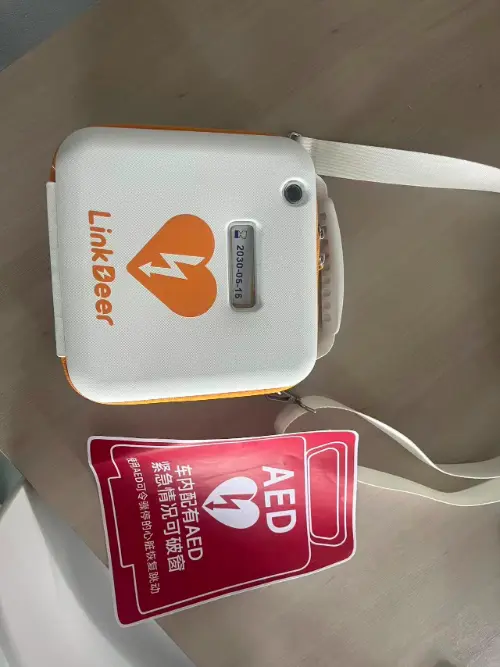
A new AED, company-wide emergency training and a long-term health program reflect how the glass bottle manufacturer defines quality — starting with its own team
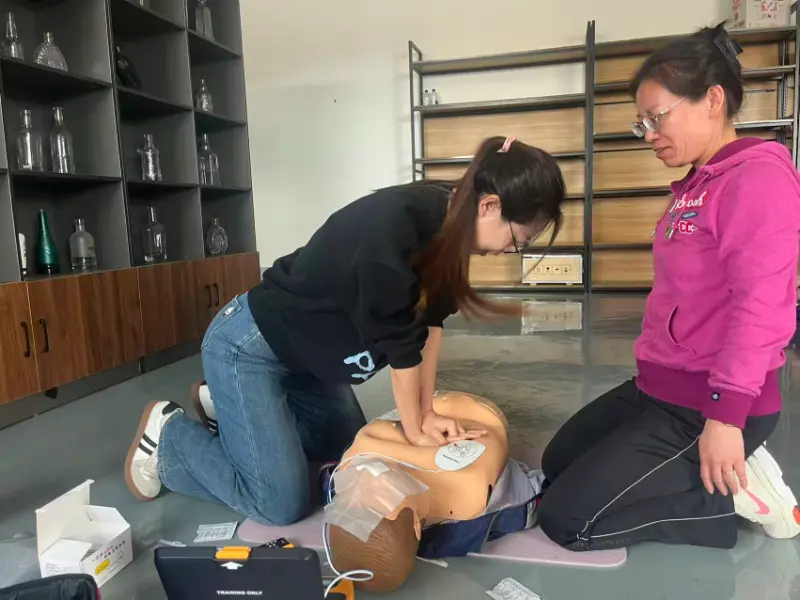
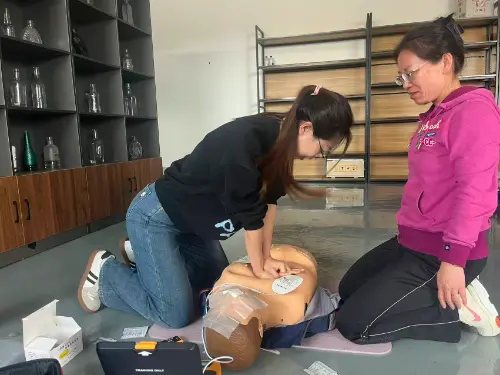
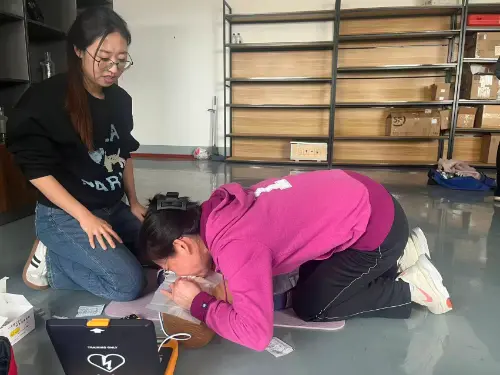
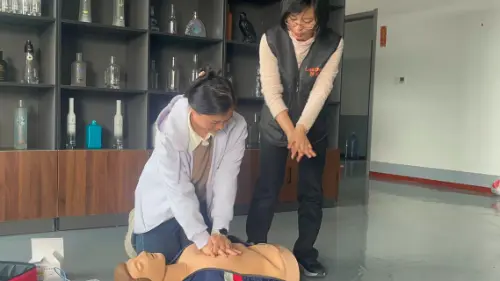
In an industry measured by tolerances, defects per batch and on-time delivery, HYT Packaging has extended its definition of quality to a new subject: the health and safety of its own employees. Recently, we installed an automated external defibrillator (AED) at completed hands-on CPR and AED training for its entire workforce.
The Decision
When the purchase request reached HYT Packaging's management, it moved through approval faster than any recent procurement — unusual in a company that reviews every quote, lead time and payment term line by line.
The rationale was stated plainly: the device was bought for the employees, not for the company.
"Safety in glass manufacturing has always meant managing the visible hazards — heat, glass, forklifts, heavy pallets," said Roger, General Manager. "A cardiac arrest is different. It doesn't check job titles or schedules, and it doesn't wait for an ambulance. The only thing we control is whether the right equipment and the right skills are already on site when it happens."
That last point carries particular weight in an industrial-park setting. Professional emergency medical services in the area typically require 10–15 minutes to arrive — while survival odds for sudden cardiac arrest drop roughly 10 percent with every minute that passes without CPR and defibrillation. The American Heart Association estimates that immediate bystander CPR paired with early AED use can double or triple a victim's chance of survival.
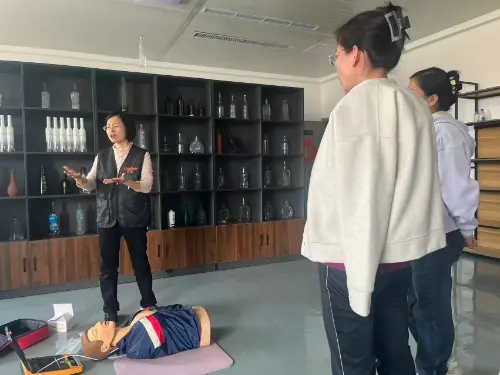
Training Everyone, Not Just Designees
During program planning, a leaner alternative was on the table: certify one or two designated employees per department and cover the rest through posted instructions. Management rejected it.
The reasoning came down to a fact every first-aid authority emphasizes: the first bystander on the scene of a cardiac arrest is random. Designated-responder training, by definition, leaves everyone else as a spectator — and any spectator could be the only person standing next to a collapsed colleague.
"Either we don't install it, or everyone learns to use it," said Roger, General Manager. "A defibrillator that no one is confident using is an expensive box on the wall."
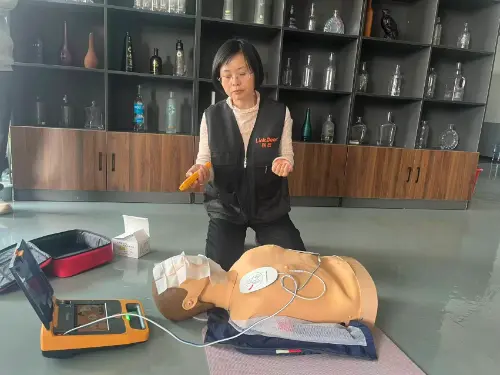
The resulting program, delivered by certified instructors from training organization, required every participant to complete a full simulated rescue individually: victim assessment, emergency call, high-quality chest compressions on feedback manikins, AED pad placement, rhythm analysis and defibrillation under the device's voice prompts.
The equipment choice surprised many first-time users. The AED analyzes the patient's heart rhythm itself and will not deliver a shock unless one is required; the rescuer's role is to start early, follow the audio instructions and keep everyone clear during analysis. As one participant put it, "the machine makes the medical decisions — you just have to act."
Why It Matters in This Industry
Glass bottle manufacturing is physically demanding work. Industry experience shows that sustained physical workload, combined with shift patterns, makes cardiovascular readiness a genuine occupational concern, not a theoretical one.
The company's safety management system has long covered mechanical and thermal hazards: protective equipment, fire drills, equipment inspections. The AED program closes the gap those measures were never designed to address — sudden medical emergencies on site.
What Comes Next
The installation and training are structured as the first phase of a rolling workplace health program rather than a one-time event. Confirmed and planned measures include:
· Semi-annual refresher training and a first-aid module in onboarding for all new hires;
· Monthly AED checks — self-test status, battery and pad expiration — logged by the administration team;
· Emergency response signage with AED locations and response steps across all facility areas;
· A trained-responder roster integrated into the site emergency plan, identifying certified responders by department and shift ;
· Annual cardiovascular-focused health screenings in cooperation with local medical partner ;
· Expanded first-aid stations in remote production and warehouse areas .
Items still in planning are published deliberately, company notes: employees seeing the direction of the program is part of the commitment itself.
The Broader Return
There is a second return on this investment : the skills leave the building. Every employee trained is also a family member, neighbor and commuter who can now respond to a cardiac emergency anywhere it happens — at home, where aging parents are often the first concern.
"Most of our team will never need this at work, and we genuinely hope they never use it at all," said Roger, General Manager. "But if the day comes — here, on the street, or in someone's living room — the people of HYT Packaging will know exactly what to do in the first four minutes. That is the standard we chose to hold."
Related News
Leave me a message
New Products


News Recommendations